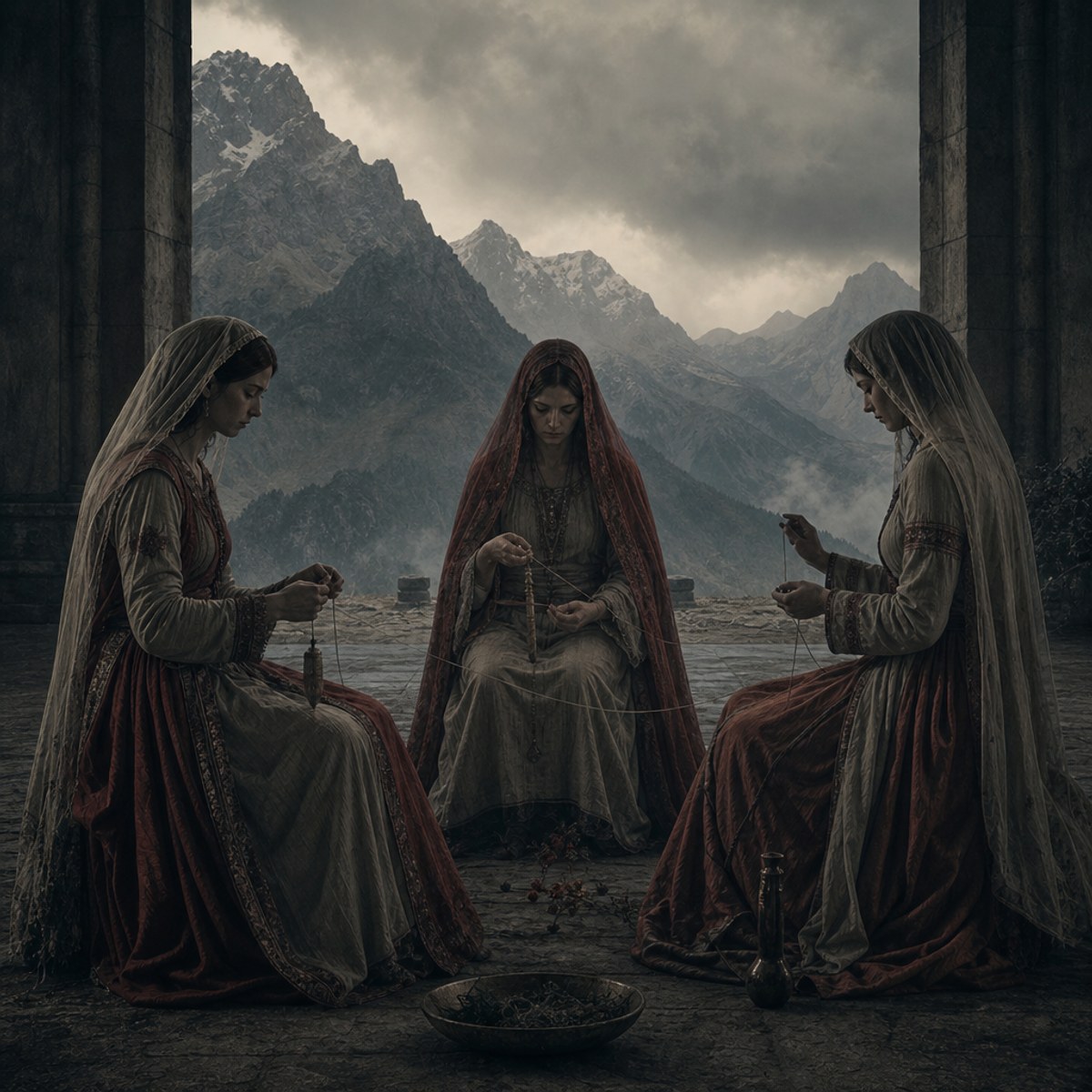
Story paths
Description
Signs
Belief-signs this figure carries.
Motifs
- tosk fate triad
- third night cradle visit
- destiny written on forehead
- bind or cut life thread
- honey almonds bread offering
- door ajar dogs out
- spindle thread scissors moira
- youngest fairy prevails
Lead story
Aliases
Fatí · Fatia · fatía · Fatat · Fatite · fatí/të · Miren · fata mirë · fatmire · nafaka · nafakë
Region
Tosk South (southern Albania); Çamëria bridge via Vitore; Kosova lexical overlay as nafaka
Relations
- Enji (Thursday / fire name)linked in story
- Bollalinked in story
- Mira (fate fairies)cradle triad
- Oracradle fate kin
- Shtojzovalle (dance spirits)not the Jashtëme host
- Vitore (Household Serpent)Çam role bridge
- Mother of the Hearthnear
- Zana (mountain nymph)related, sense-split
Linked stories
Three invisible old women (Fatite, pl.) on the third night: dogs out, door ajar, honey + three almonds + three breads. They write/bind/cut fate; youngest word may prevail. Tosk–Lab center. Nafaka (Kosova lot lexeme) redirects here — not a second triad. Çam twist sits on Vitore↔Fatí role bridge, not here.
Të mirat ≈ Fatí near-synonym (Tosk fate face); butterfly/dream aid. Elsie zonja të jashtime under Mira = southern fate gloss ONLY. Northern Zónja të Jáshtëme → Zana. të tri gratë → Fatia. ≠ Shtojzovalle.
- Or-prem — cut by the oraRecorded
Idiom or-prem / orëprerë: fate-thread cut by ora howl/reprimand. Northern thread talk —
Benign colourful serpent in wall niche/foundation; hiss announces family events; kill taboo risks line extinction. South name Vitore; north Ora e Shtëpisë / Gjarpni i Vatrës. Kosova Doli carvings. Not the same as Wild. bolla; alias Bolla e Shtëpisë → vitore.
Southern fate-ladies (Fatia / Mira) densify in Lab–Tosk cradle and third-night decree lore. Northern Jashtëme speech is a different sense. Regional color for the cradle complex — not a northern Ora or Zana synonym.
- Arbëresh fate retention vs Zónja–Zana cloudReconstructed
Tosk Fatí/Mira vocabulary may appear in Arbëresh, but Zónja të Jáshtëme often tracks the zana gentler name cloud. Route by sense: cradle-fate → fatia/mira; martial nymph → zana. No local_fatia. High Italian fata contamination risk.
- Çamëria Vitore = Fatí role (regional bridge)Reconstructed
Pedersen/Doja/Elsie: in Çamëria Vitore plays birth-fate / spinner role. High regional —
- Myzeqe fate/hearth ecology (honest thinness)Reconstructed
Myzeqe lowland houses participate in Tosk Fatí/Mira third-night ecology and Vitore hearth serpent — no independent Myzeqe-only monster atlas or Olympian plain family of gods recorded this sweep. Map as belt ecology, not invent.
- Bardha mist ≠ Ora e Bardha colourEditorial
C bardha mist maidens (honey/cake; tread→mute) are distinct from Dukagjini e Bardha/e Verdha/e Zeza fate allotment on ora.
- N–S fate split: Fatia/Mira vs OraEditorial
Same cradle-fate work: South Fatí/Mira, North Ora (C). Functional homology; never identity merge. Epic serpent-Ora / Mujo stays on C ora.
Labels: (1) Fatia/Fatí/Fatite/të tri gratë — same triad. (2) Nafaka → Fatia. (3) Mira/të mirat — soft fate face. (4) Jashtësme — SENSE-SPLIT (N→Zana; Elsie S→Mira field only). (5) Çam Vitore↔Fatí role bridge. Ora ≈ northern cradle homology.
Same string family, two hosts. (1) Northern/Gheg–Arbëresh: Zónja të Jáshtëme = polite gentler name for Zana — primary living sense for many speakers. (2) Elsie 2001 s.v. Mira: zonja të jashtime in southern fate vocabulary — dictionary sense only. Never dump all Jashtësme onto Mira; never host under Shtojzovalle dance-death.